Topics & AI insights
Topics & AI insights
Automatic analysis of every conversation — what customers talk about, how they feel, and which conversations need your attention.
Asks analyzes every conversation automatically. When a conversation closes, the AI reads it and extracts a summary, topics, sentiment, language, and anything noteworthy; conversations that never formally close are picked up once they've been idle for a day. Nothing here requires manual tagging — the pages below fill up as conversations happen, and update as new ones arrive.
These four pages — Topics, Sentiment, AI Insights, and Team Business and up — are available on the Business plan and above.
Topics
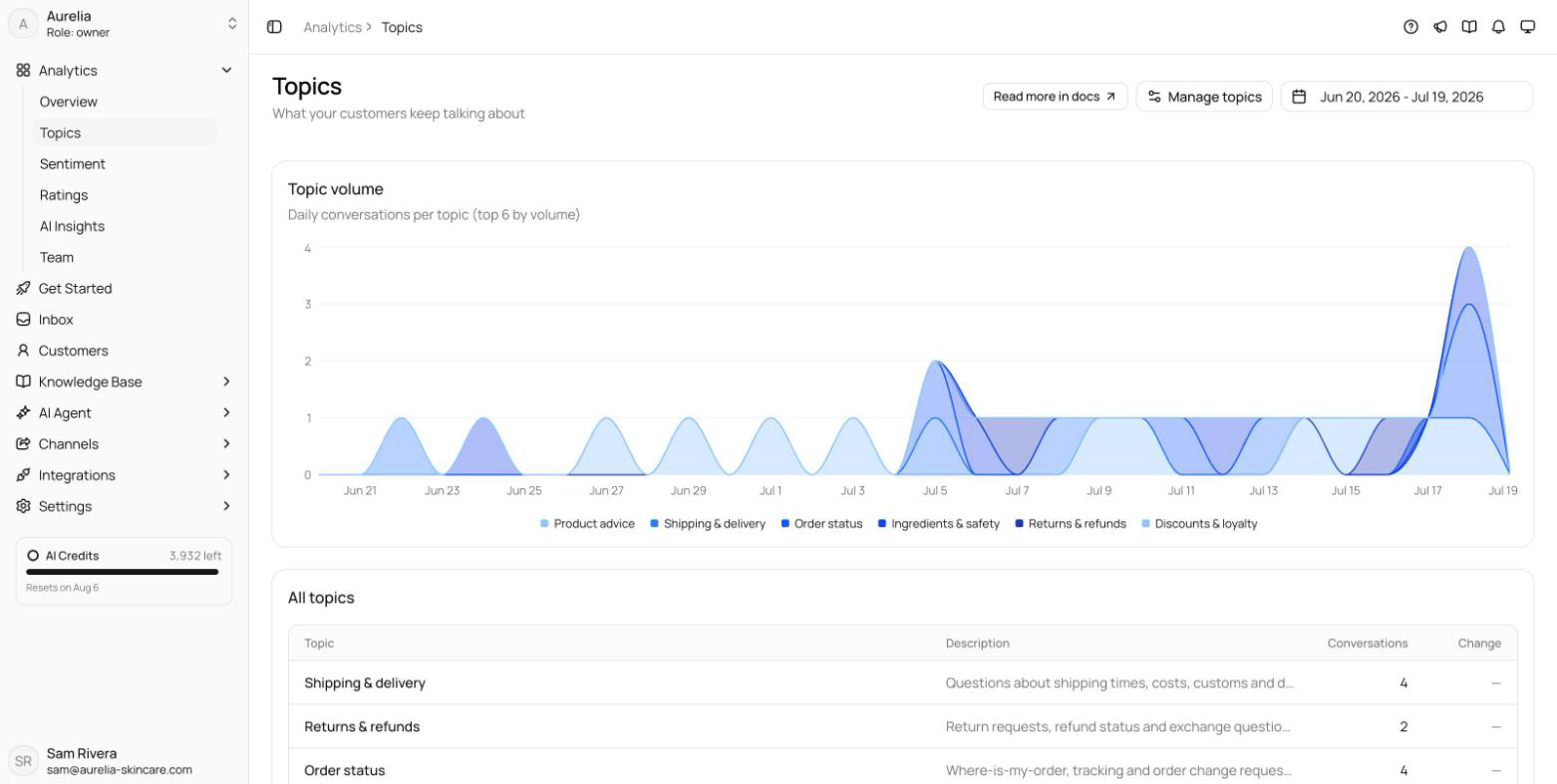
Topics answer "what do customers keep talking about?" The page charts daily conversation volume for the six biggest topics, and the All topics table lists every topic with its volume and change versus the previous period.
There are two kinds:
- Custom topics — you define up to 12 active topics, each with a name and a plain-language description ("Shipping delays — customers asking where their order is"). The AI classifies every new conversation against them. New topics apply to new conversations, not retroactively.
- AI-detected topics — themes the AI spots on its own, ranked by volume. Useful for finding topics you haven't defined yet.
Sentiment
Sentiment answers "how do customers feel?" Conversations are classified Positive, Neutral, Negative, or Angry. The page shows counts per class, sentiment over time, and a list of recent negative conversations you can open directly in the inbox. Angry is detected in realtime during the conversation — it's also what can trigger escalation to a human.
AI Insights
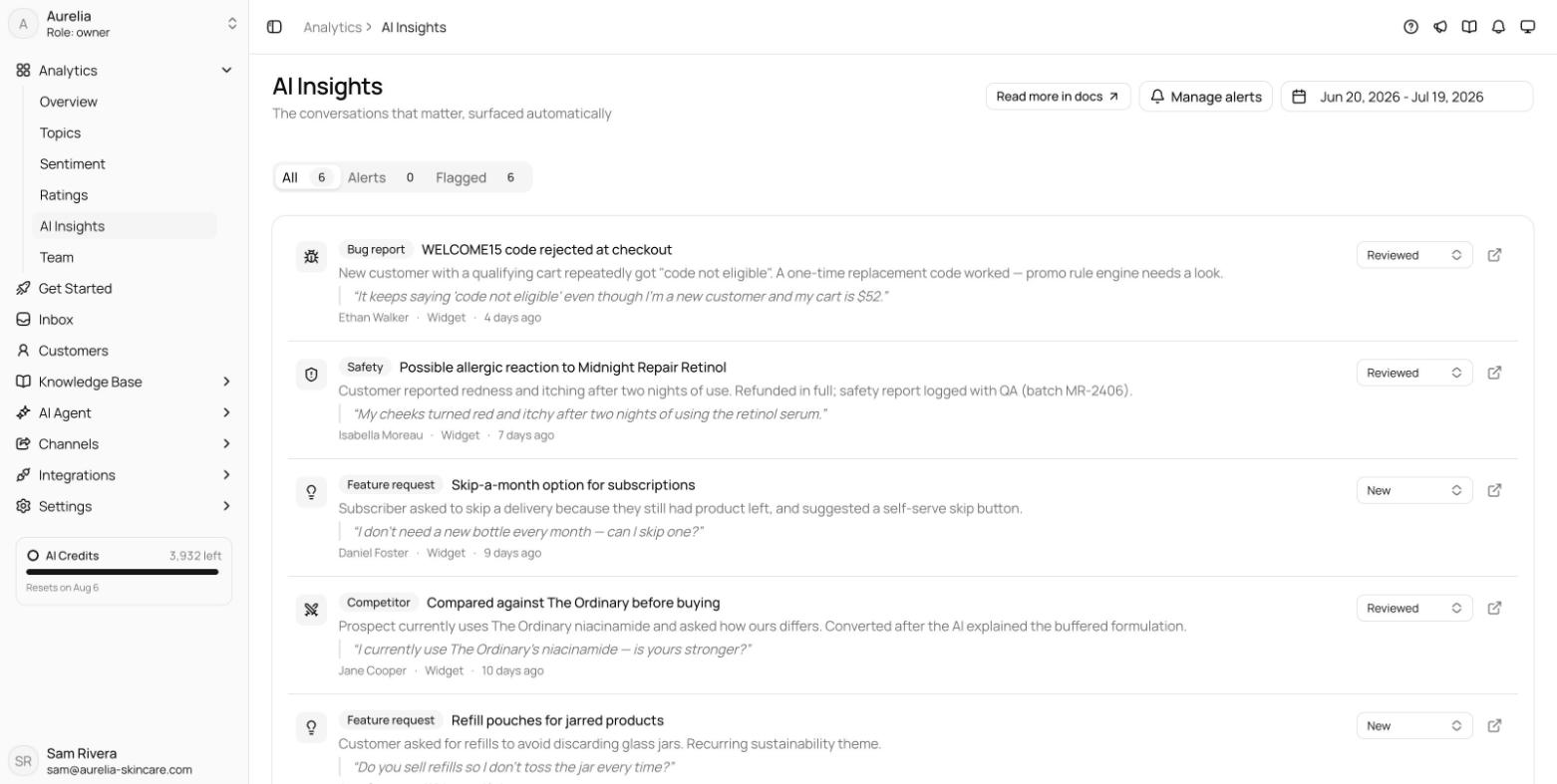
AI Insights is a feed of the conversations that matter, surfaced automatically. With no setup, the AI flags feature requests, bug reports, competitor mentions, churn risks, and safety issues as it analyzes conversations. Each item shows what was flagged, a quote from the conversation, and a link to it; mark items Reviewed or Dismissed as you work through the feed. Tabs filter the feed to All, Alerts (your custom alerts only), or Flagged (the built-in detectors).
You can add your own detectors: Manage alerts lets you define up to 10 alerts in plain language — "customers threatening to cancel", "mentions of our enterprise plan" — and the AI matches every new conversation against them. Each alert shows its match count and last match, and has a switch to pause it without deleting it.
The Knowledge Gaps block at the bottom of this page groups the questions the AI couldn't answer and lets you fix each one by publishing a drafted article — see the analytics overview.
Team
Team answers "how do humans perform after the AI hands off?" It shows:
- First response after handoff — median and p90 time from handoff to the first human reply. Stats need at least 5 handoffs in the period; smaller samples are suppressed.
- SLA performance — if your workspace uses SLA policies, attainment per metric (First response, Next response, Resolution) with met versus breached counts, a live line of open conversations currently at risk or breached, and a per-policy attainment table.
- Agents — per-agent messages, resolved conversations, and CSAT.
- AI health — the agent's own reliability: success rate, failed turns, model failover, judge interventions, and reply latency.
Counts reflect when conversations are analyzed, not when they happen: closed conversations are analyzed immediately, and open ones after about a day of inactivity. A busy conversation from this morning may not show up in Topics yet.
Related
- Analytics overview — KPIs, charts, and plan retention.
- Ratings & CSAT — what customers say when you ask.