Tickets, tags & SLAs
Tickets, tags & SLAs
How conversations and tickets relate, and how to organize your queue with tags, canned responses, and SLA policies.
Every conversation in Asks has a lightweight ticket behind it. The conversation tracks the dialogue; the ticket tracks the work — status, priority, tags, and SLA deadlines. There is no separate tickets area: everything lives in the inbox, and a ticket link opens its conversation there.
Conversations vs tickets
Tickets are created automatically when a conversation starts. They're numbered sequentially per workspace and shown as #123 on inbox rows and in the customer panel.
| Values | What it tracks | |
|---|---|---|
| Conversation status | Open, Closed | The state of the dialogue with the customer. |
| Ticket status | Open, In progress, Closed | Your team's workflow on that conversation. |
| Ticket priority | Low, Normal, High, Urgent | Urgency. Defaults to Normal. |
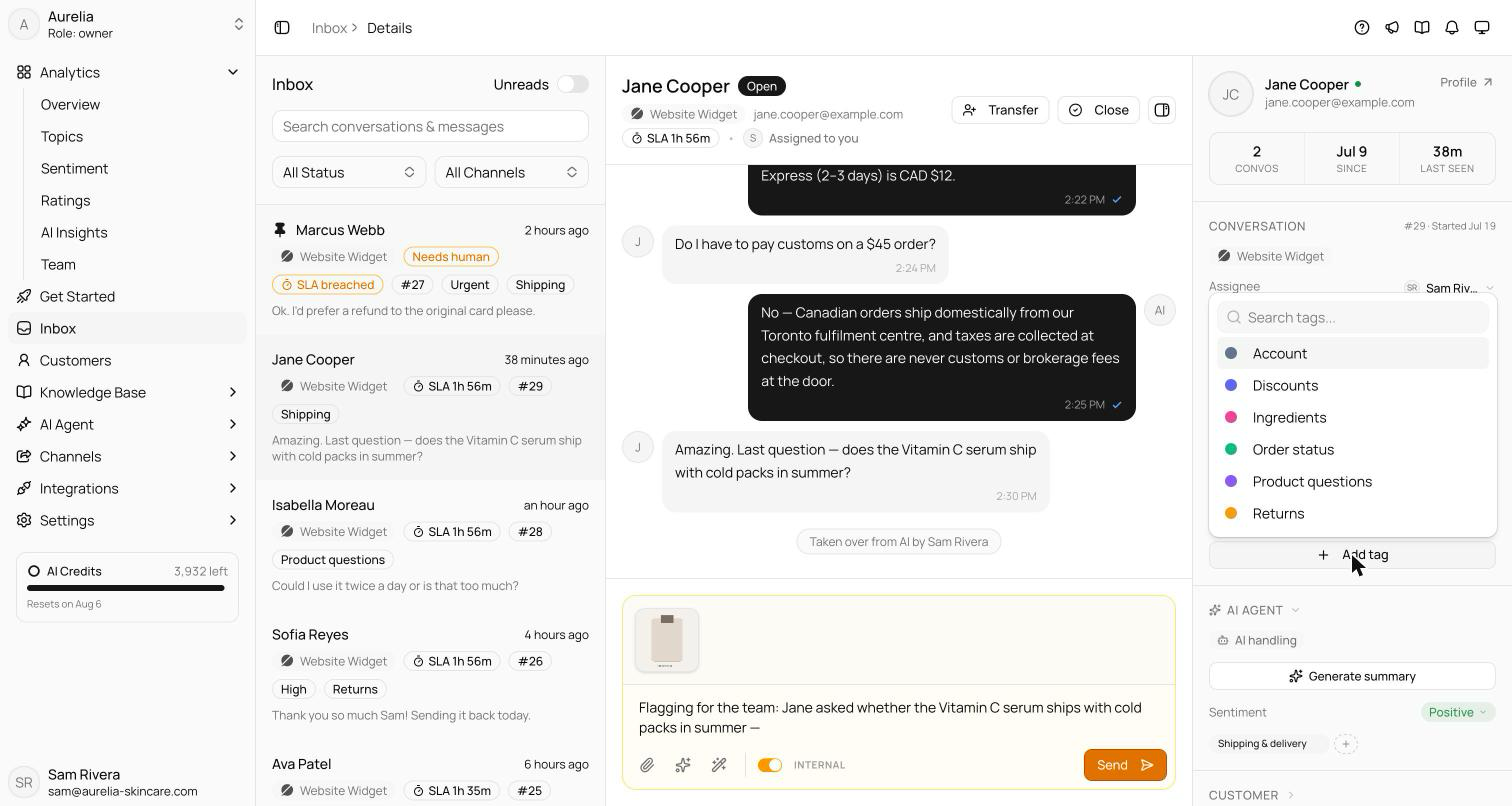
In progress is set automatically when a teammate takes over; the status control itself offers Open and Closed. Edit ticket status, priority, and tags in the customer panel's Conversation section. Resolving or closing a conversation closes its ticket.
How AI resolve and reopen work
The AI agent can resolve conversations itself: when a customer confirms they're done, it sends a friendly closing message, closes the conversation — recorded as resolved — and closes the ticket. Conversations that go quiet are eventually closed as resolved automatically as well.
Resolving is safe and reversible. If the customer writes again — minutes or weeks later — the conversation reopens automatically. Closed tickets are never reopened; instead a fresh ticket is created and linked to the previous one, so each round of work keeps its own record and SLA clock.
Tags
Tags are workspace-controlled labels for categorizing conversations. Manage them at https://app.asks.app/settings/workspace/tags: each tag has a name and an optional color, and can be deactivated when you retire it. In the inbox, you pick from this predefined list — tags can't be free-typed on a conversation, which keeps reporting clean. Separately, the AI assigns topics as it analyzes conversations; those appear in analytics and in the customer panel's AI Agent section, where you can edit them — they never mix into your tag list.
SLA policies Business and up
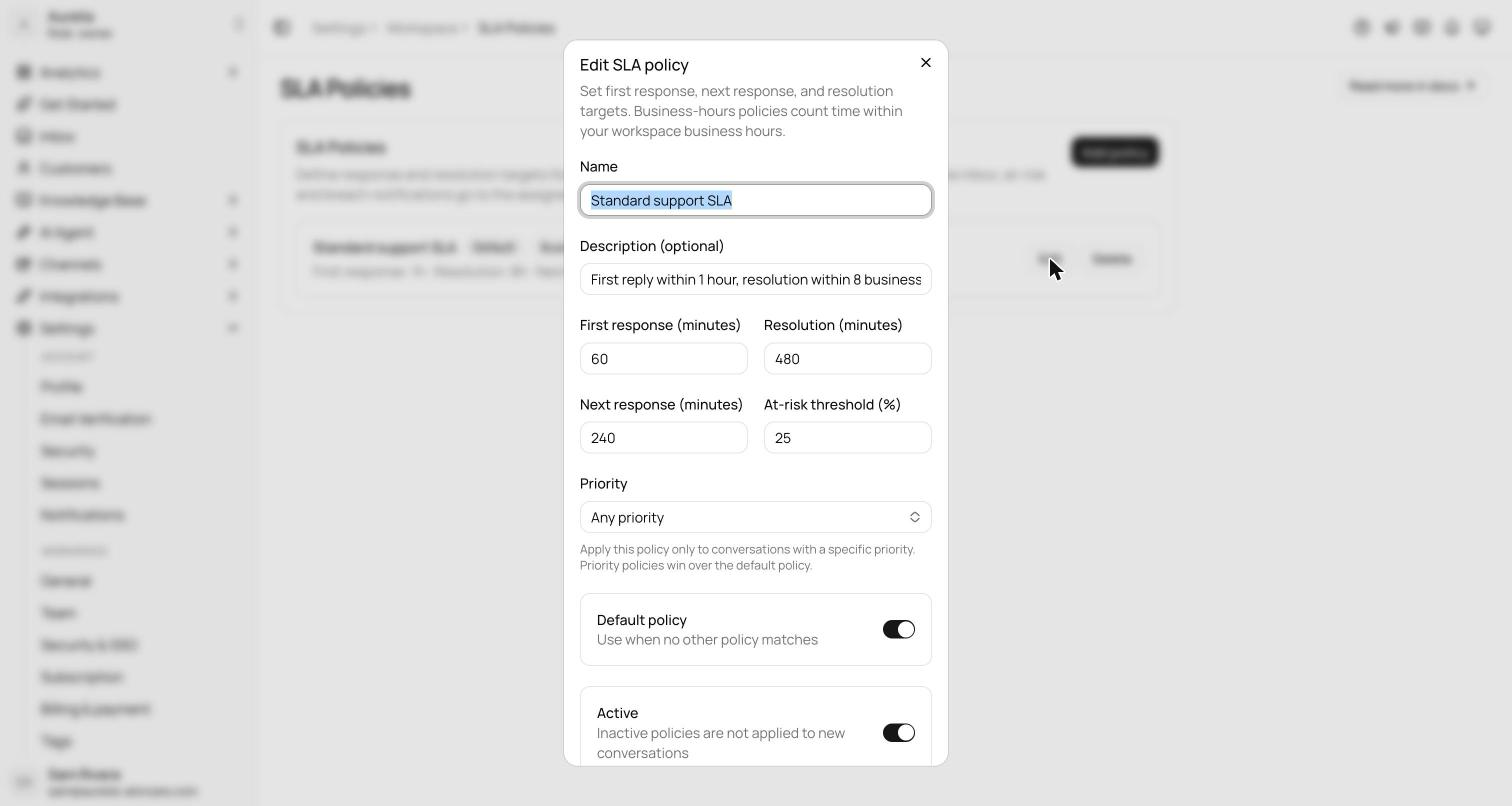
SLA policies set response-time targets for your team. Manage them at https://app.asks.app/settings/workspace/sla-policies.
Each policy defines:
- First response, optional Next response, and Resolution targets, in minutes
- an optional priority — a policy targets one priority (or every ticket when left blank), so create one policy per priority to give urgent tickets tighter targets
- a default policy flag, used when no other policy matches
- a business hours only toggle — pause the clock outside working hours, so a ticket that arrives Friday night isn't breached by Saturday morning. The hours, days, and closed dates themselves are configured once per workspace and follow your workspace timezone.
- an at-risk threshold — the percentage of time remaining that flips a ticket to at risk (default 25%)
Tickets are scored on track, at risk, or breached. When a ticket becomes at risk or breached, the assignee — or, when unassigned, the workspace owners and admins — gets an email alert (controlled by their notification preferences), and the sla.at_risk and sla.breached webhooks fire. SLA state shows throughout the inbox: countdown chips on list rows and in the transcript header, due dates in the customer panel, and the SLA at risk / SLA breached list filters.
Canned responses
Canned responses are reusable replies your team inserts with / in the inbox composer. Manage them at https://app.asks.app/settings/workspace/canned-responses. Each has a name, the reply content, an optional shortcut (like /refund), and a visibility — personal, team, or workspace. A canned response can also carry attachments, staged with the reply when you insert it.
Content supports {{variable}} tokens, filled in at insert time:
| Root | Examples |
|---|---|
customer | {{customer.name}}, {{customer.email}}, {{customer.phone}} |
ticket | {{ticket.number}}, {{ticket.status}}, {{ticket.priority}}, {{ticket.tags}} |
conversation | {{conversation.status}}, {{conversation.priority}} |
agent | {{agent.name}}, {{agent.email}} |
workspace | {{workspace.name}} |
A canned response can also carry actions — set status, set priority, add tags — that run after the reply sends. Actions are currently configured through the API.
Related
- Takeover & collaboration — using canned responses and notes in the composer.
- Plans & limits — what each plan includes.