Turn your support address into an Asks channel with a single forwarding rule — no DNS changes required.
The Email channel turns an address like support@yourcompany.com into a channel. You keep your address and your mail provider; you add one forwarding rule to a hidden Asks address, and inbound mail becomes conversations in the inbox. The AI agent can answer email too, and replies thread correctly in the customer's mail client.
Availability — this channel is rolling out and may not be enabled for your workspace yet. It will appear under Channels in your dashboard as soon as it's available.
Prerequisites
- A support address you control (e.g.
support@yourcompany.com). - Access to that mailbox's forwarding settings — Gmail, Google Workspace, Microsoft 365, or any provider that can auto-forward.
Connect email
Go to app.asks.app/channels/email, enter your Support email address and an optional Display name (e.g. "Support"), and click Connect email.
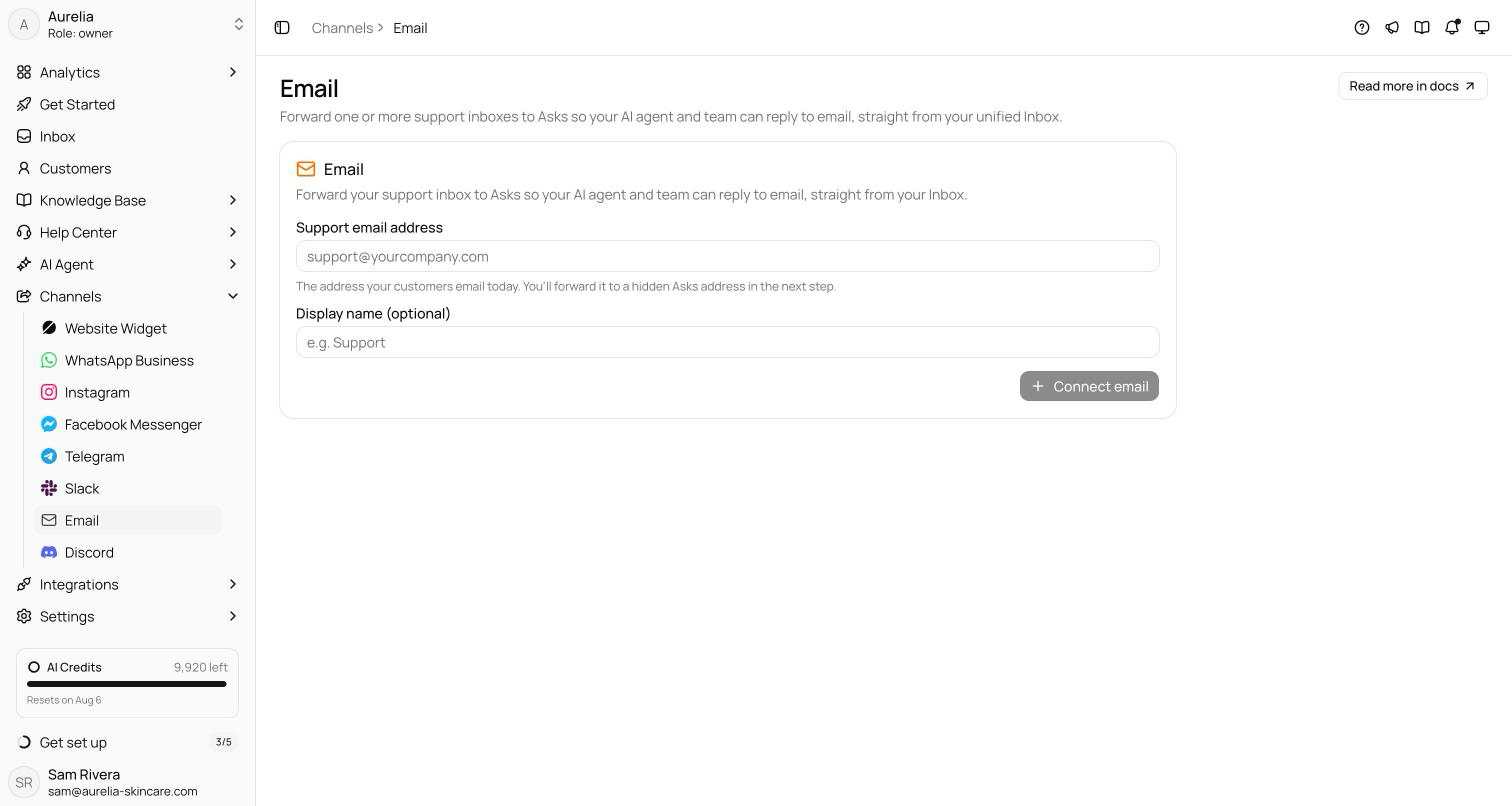
Asks mints a unique ingest address for this channel, in the form inbound+<token>@inbound.asks.app. Copy it from the channel page — this is where your provider will forward mail. Customers never see it.
The channel page shows instructions for Gmail, Google Workspace, Microsoft 365, and other providers. For Gmail: Settings → See all settings → Forwarding and POP/IMAP → Add a forwarding address, paste the hidden address, confirm, then choose Forward a copy of incoming mail. In Google Workspace, an admin can instead add a routing rule for the whole address.
When you connect, Asks sends a probe email to your support address. Once your forwarding rule passes it back, the channel flips to Verified. Use Check status on the channel page to refresh.
Verify it works — send an email to your support address from a personal account. It should appear as a conversation in your inbox, and the reply you send from Asks should land back in the personal account's thread.
You can connect more than one support address — Add another email address on the channel page — and each becomes its own channel.
How replies work
- Replies from the Asks inbox carry a per-conversation reply address (
reply+<token>@inbound.asks.appas the Reply-To), so customer responses thread back into the same conversation. Standard mail threading headers are set as well. - Outbound mail is sent from Asks's sending domain with your display name as the sender name. Optionally, verify your own domain on the channel's Branded Domain tab (publish the DNS records shown, then click Verify) to send from your own address.
- There are no messaging-window restrictions — reply whenever you like.
- Attachments work both ways. Inbound attachments over 20 MB each are skipped while the message itself still arrives; large outbound files are delivered as download links. CC recipients on inbound mail are captured, and you can CC or BCC replies.
- Automated mail is filtered to prevent loops: out-of-office and other auto-responders, bulk and mailing-list messages are dropped, and mail your provider flags as spam is stored without triggering an AI reply.
- If a reply hard-bounces or the recipient marks it as spam, the message shows a failed badge in the inbox and the address is suppressed from further sends.
Settings
On the channel's settings tab: Email channel active (master switch — when off, mail is received but no replies are sent), AI agent replies (let the AI answer inbound email), Auto-reply (an automatic acknowledgement — it fires only on the first email of a new conversation, and never when the AI agent is about to answer), Reply-from address, and Signature (appended to every outbound reply).
Troubleshooting
The channel is stuck on "Awaiting forwarding verification"
The forwarding rule isn't live yet. Gmail requires you to confirm the forwarding address before it forwards anything, and some providers delay new rules. Re-check the rule, then click Check status.
Replies go out from an Asks address, not mine
That's the default shared sender. Verify your own domain under Branded Domain to send from your address.
A customer's reply opened a new conversation
Replies thread by the reply token and message headers. If a customer starts a fresh email instead of replying, it becomes a new conversation by design.
My out-of-office test didn't create a conversation
Expected. Auto-generated mail — out-of-office replies, auto-responders, bulk sends — is dropped to prevent reply loops. Test with a normal, hand-written email instead.