MCP servers
MCP servers
Connect external MCP servers so the AI agent can use their tools in customer conversations.
The Model Context Protocol (MCP) is an open standard for exposing tools to AI models. Connect an MCP server — your own or a vendor's — and the Asks agent discovers its tools and can call the ones you enable during customer conversations, on every channel and in the Playground. Manage servers at app.asks.app/ai-agent/mcp-servers.
Plans allow 1 server All plans, 3 Business and up, or 10 Premium. See Plans and limits.
This page is about the agent consuming external MCP tools. The reverse — exposing your Asks agent as an MCP server that other AI apps can call — is covered in MCP endpoint.
Add a server
Give it a name (for example "Acme CRM tools") and the server URL, such as https://mcp.example.com/mcp. Only https:// URLs work, and the server must be reachable on the public internet — localhost and private networks are not supported.
No authentication, Bearer token, or API key header. For an API key you also name the header (for example x-api-key). Secrets are encrypted at rest and never returned to the dashboard — and changing the server URL clears the stored secret so it's never sent to a new host.
Asks connects to the server and discovers its tools with an MCP tools/list call (up to 40 tools per server). On success you'll see how many tools were found and that they're now live in customer conversations; all of them start enabled.
Manage tools
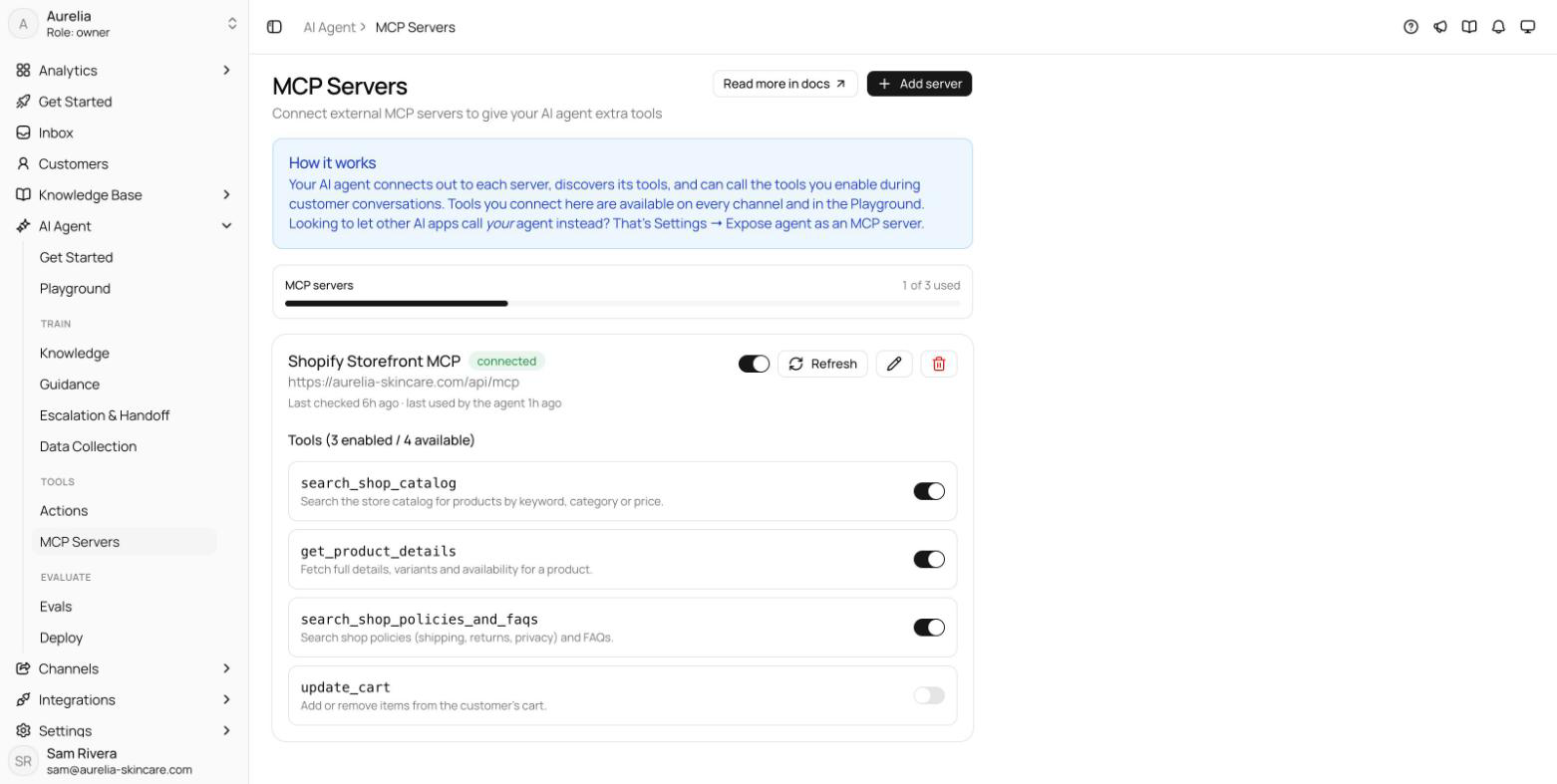
Each connected server shows its status — connected, error, or disabled — with a "Last checked" line and, once the agent has called it, when it was last used. The tools list reads "Tools (N enabled / N available)" with a switch per tool: disable any tool you don't want the agent calling; only enabled tools are offered to the model. The Enable server switch pauses the whole server — its tools stop being offered — without deleting anything. Refresh re-runs discovery after the server's tool list changes, and removing a server cuts the agent's access to its tools immediately and deletes the stored secret.
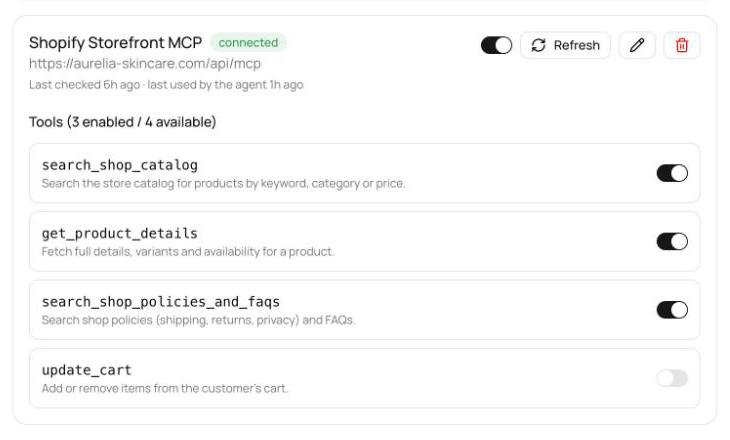
After connecting, open the Playground and ask a question that should hit one of the new tools. If the server shows an error badge instead, the card tells you what to fix — rejected credentials, a URL that isn't an MCP endpoint (most end in /mcp), a timeout, or a server that isn't publicly reachable — then hit Refresh.
How the agent uses MCP tools
Enabled tools join the agent's toolbox alongside custom actions and built-ins. The tool's own name and description tell the model when to call it — so a well-described server needs no extra prompting. If a tool call fails mid-conversation, the agent answers without it rather than exposing the error to the customer, and the outage shows up on the server card as an error status with the last error message.
Prefer custom actions when the capability is a plain HTTP call against your own API; reach for MCP when a system already speaks the protocol or ships many tools at once.